
|
In this issue... |
|
APTI
and VA Awarded NCPTT Research Grant VA
in the News: Architectural Record ________________________
To be removed from or subscribe to this newsletter,
please email newsletter@vertical-access.com
To view previous VA Quarterlies, please go to our website |

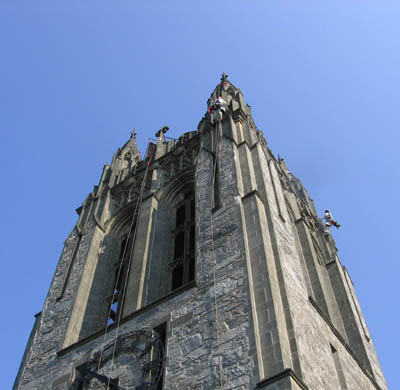 Gasson Hall |
Vertical Access, working with McGinley Kalsow & Associates LLP
(MKA), Building and Monument
Conservation and LeMessurier Engineering recently completed an
investigation of the masonry tower of Gasson Hall at Boston College.
Gasson Hall was designed by Charles Donagh Maginnis of the Boston
architectural firm of Maginnis and Walsh as part of the master plan for
the new Boston College campus in Chestnut Hill.
Constructed between 1909 and 1913, Gasson Hall is one of the
earliest examples of Collegiate Gothic design, a style that incorporates
Gothic Revival ornamentation with Beaux-Arts building and site planning.
The influence of Gasson Hall and its notable tower can be seen in
significant buildings at many other college campuses, including
Cleveland Tower at Princeton University, Harkness Tower at Yale
University, and the Chapel Tower at Duke University.
Gasson Hall currently contains administrative offices and
classrooms as well as an assembly hall on the ground floor, and retains
much of its original decoration and ornamentation.
Gasson Hall is of interest not only because of its noteworthy
architectural design, but also because of the masonry materials used in
its construction: cast stone, used at Gasson Hall to simulate both
granite and limestone,
and puddingstone, a local conglomerate stone.
The tower of Gasson Hall serves as a clock tower and belfry for the
campus. Like the
three-story structure from which it rises, it is constructed of
load-bearing masonry exterior walls with wood and steel floor and roof
framing. The interior of
the tower is accessed using a spiral staircase that can be reached
through a small room at the third floor of Gasson Hall.
The first interior floor of the tower, the clock room, has narrow
rectangular window openings. The next floor at the tower interior is the bell level, which
is expressed on the exterior with tall arched bipartite openings,
currently covered with hardware cloth.
The interior stair climbs from the belfry level to the tower roof
at the southwest corner of the structure. At
the roof level, there is a tall crenellated parapet and four tall corner
turrets that crown the tower.
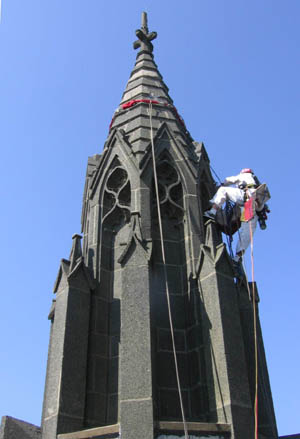 Gasson Hall |
On the exterior, cast stone is used for the decorative units, including the quoins, corner piers, window surrounds, tracery, crenellated parapet and octagonal turrets. Puddingstone in random rubble coursing is used in the field of the walls at the lower portions of the tower. At least some of the cast stone used at Gasson Hall originally had a smooth buff finish, which is still visible at protected areas of the exterior such as the deep moldings of the arched openings. At the corners of the tower, the cast stone is darker and has a more heterogeneous structure; the assumed intent is that the cast stone was manufactured to mimic granite. Many ashlar units also still display a rilled tooling pattern that would have given the appearance of natural stone.
Cast
stone is a cementitious building product manufactured in molds to
simulate natural stone and used in unit masonry construction. Although cast stone had
been produced in the United States since the period immediately
following the Civil War, its use at Gasson Hall predates many of the industry standards and specifications that were developed in
the 1920s and 1930s. The
early appeal of cast stone for architects and builders was the variety
of shapes, colors and textures that could be created. The
cast stone used in the tower of Gasson Hall has a coarse texture,
although some of its coarseness may be due to weathering rather than
intended design effect.
As a cementitious product, cast stone is vulnerable to the same types of deterioration that affect other concrete products, including carbonation, aggregate-alkali reactions, freeze-thaw cycling and erosion. Because it is constructed as unit masonry, cast stone is also affected by differential movement and systemic cracking that is often seen in traditional masonry construction. When used with materials having dissimilar physical and chemical properties, such as natural stone, the interaction of the two materials can also result in deterioration.
The natural stone used in the field of the exterior walls at Gasson Hall is primarily puddingstone with some granitic fieldstone present as well. Puddingstone is a sedimentary stone, but one without well-defined bedding planes. Structurally, it is more of a conglomerate with a variety of large inclusions in a relatively hard matrix. Sometimes called Roxbury stone, it was quarried locally and commonly used in stone foundations and walls in the Boston area. Puddingstone in a variety of colors and units having a wide range of sizes is used at Gasson Hall. One of the characteristics of the natural stone masonry at Gasson Hall and puddingstone in general is the uneven coursing and heterogeneous appearance of the stonework. There are also wide joints with a beaded profile that protrudes from the plane of the masonry, although the original mortar may not have been less conspicuous. Overall, the puddingstone is also a very hard and durable stone and at Gasson Hall it is in relatively good condition.
Investigative work on Gasson Hall is still in process. McGinley Kalsow & Associates and Building and Monument Conservation are currently surveying the lower part of the structure. Their findings of field conditions, supplemented by archival research, will produce additional insights into the design, construction and current condition of the building.
For more information, view the project profile of Gasson Hall on our website.
-Evan Kopelson [Photos by Evan Kopelson and Mike Gilbert]
The New York City Department of Buildings Recognizes Rope Access
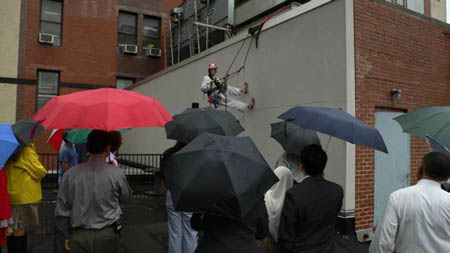 Industrial rope access demonstration at the NYC DOB |
In late August, the New York City Department of Buildings, Cranes and Derricks Unit issued a fact sheet that officially recognizes industrial rope access as a safe and viable means of inspecting building facades in New York City for holders of the NYC Special Rigger's License.
Vertical Access had the pleasure of educating the DOB on rope access and ultimately presented an industrial rope access seminar and demonstration at DOB headquarters in downtown Manhattan.
This is a crucial first step which gives IRA technicians the filing and certification procedures we can follow to work legally in the city.
For more information, please see the fact sheet on the DOB website.
-Kelly Streeter
APTI and Vertical Access Awarded NCPTT Grant
In July, The Association for Preservation Technology International (APTI), in conjunction with Vertical Access, was awarded a research grant from the National Center for Preservation Technology and Training (NCPTT). The project is intended to be a first step in improving design and specification of anchor bolts in stone masonry. The primary inspiration for this project is the dearth of applicable field research in mechanical expansion and thread-type anchors in contrast to the many shear and pull-out investigations of injection or adhesive anchors. The lack of design values for historic masonry for these oft-used anchor systems was the impetus for the research, which involves tensile and shear testing of two types of mechanical anchor bolts in sandstone and limestone.
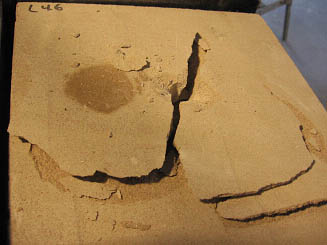 Tension cone failure in Indiana Limestone |
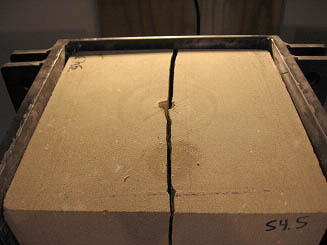 Berea Sandstone specimen split in half |
Kelly Streeter and Keith Luscinski, a Vertical Access intern, are responsible for carrying out bolt tests. Along with failure tests on the bolts, compression testing, Schmidt hammer testing and pulse velocity tests are being completed on the stone specimens to correlate shear and tensile values to compression strength of the substrate material.
The results of the research will be published in journals edited and published by The Masonry Society and/or APTI next fall. The stone cube samples were donated by Old World Stone and equipment and editorial support is being provided by Mike Schuller of Atkinson-Noland & Associates.
The testing will be completed on the Instron Model TTCM1 machine that Vertical Access owns and operates at their facility in Ithaca, New York.

Sleuthing
the Mundane and the Catastrophic
Forensic architects and engineers employ
investigative techniques, not to point fingers, but to find the root
cause and recommend solutions for problems that plague buildings.