Infrared Thermography for Buildings
Infrared waves, like radio waves and visible light waves, are portions of the electromagnetic spectrum. Just as a photograph
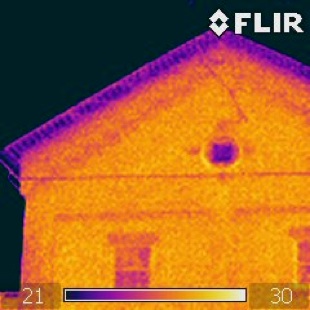
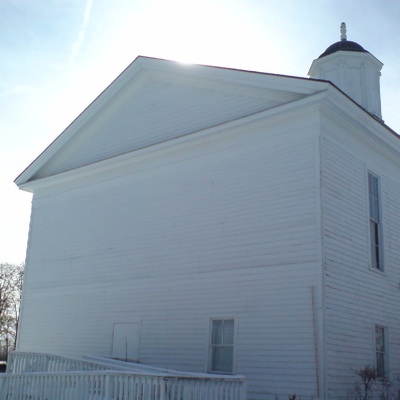
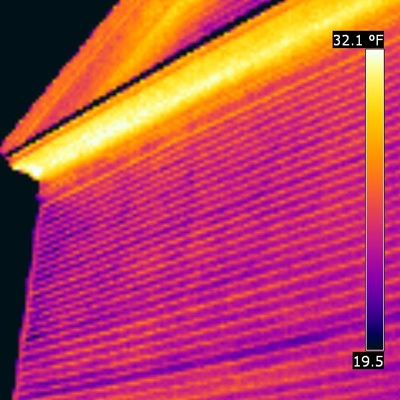
is an image of visible light captured by a camera, a thermograph is an image of infrared radiation captured by a thermal camera.
Contrary to popular belief, thermal cameras don't 'see' temperatures. Instead, they 'see' the infrared waves emitted and
reflected from a building facade. The infrared radiation emitted by surrounding objects, especially those behind the
thermographer, can have a large impact on the final thermal image. Even though typical historic facade materials, such as
concrete, natural stone or terra cotta, are poor reflectors of infrared radiation, thermal images take skill and experience
to accurately interpret.
VA primarily uses infrared thermography to locate areas of high moisture content in masonry walls. Because water
has a heat capacity approximately 5 times that of stone and concrete, a wet masonry wall will take substantially longer to
change temperature than a dry wall. Taking into account the interior and exterior air temperatures, solar loading and convective
cooling, a skilled VA thermographer can quickly find areas of possible water concentration, which can then be used to find
likely areas of infiltration.
Infrared thermography also has the capability to show the location of structural steel behind masonry facades.
Because steel is highly thermally conductive, it can often affect the temperature of nearby masonry. By capturing thermal
images at a time of day that minimizes the masking effect of direct sunlight and maximizes the interior to exterior temperature
differential, VA technicians can shed light on construction details that may not be apparent on the surface.
Perhaps the most common use of infrared thermography today is to conduct home energy audits. While VA does not
conduct full-scale energy audits, infrared images coupled with a close-up visual inspection can provide details on the
effectiveness of aging windows and perimeter sealant.
Infrared thermography is rarely a standalone tool. A good building thermographer will confirm his hypotheses
with moisture meter readings, hands-on inspections, core samples, borescope probes, or other evaluative techniques.