

|
In this issue... |
|
VA in the News: Kent Diebolt and Paul Gaudette Named to APTI College of Fellows ________________________
To be removed from or subscribe to this newsletter,
please email newsletter@vertical-access.com
To view previous VA Quarterlies, please go to our website
|

 Saint Francis de Sales |
Vertical Access, working with the Building Committee of St. Francis de Sales Church, Historic Building Architects, LLC, Robert Silman Associates, Jablonski Berkowitz Conservation, Femenella & Associates and Princeton Engineering Group, recently completed the first phase of a comprehensive investigation of the interior and exterior of St. Francis de Sales Church in Philadelphia, Pennsylvania. The church, at 47th Street and Springfield Avenue, was constructed between 1907 and 1911. Since that time, the church has played an important part in the development of the surrounding community and has stood out as a prominent icon in its West Philadelphia neighborhood. The church incorporates the efforts of a well-known local architect of religious structures, Henry D. Dagit, and the R. Guastavino Company, the prolific designer and builder of the unique construction system commonly called Guastavino vaulting. Dagit was responsible for the overall design of St. Francis de Sales Church and the detailing of the lower portions of the interior, the exterior walls and the roofs. The ceiling vaults and domes of the church were designed and constructed by the R. Guastavino Company, employing their patented system of laminated thin tile construction. Although other structures employing the use of Guastavino tile ceilings, domes and vaults may be better known than St. Francis de Sales Church, such as the Cathedral Church of St. John the Divine, the Municipal Building and Grand Central Terminal in New York City and Boston Public Library in Massachusetts, St. Francis de Sales Church in Philadelphia is significant among the numerous works in the oeuvre of the company because of the extensive use of Guastavino vaulting and the rare construction of a Guastavino tile surface exposed on the exterior of the main dome.
Built in a Byzantine Revival style, the plan of St. Francis de Sales Church consists of a large, domed central space with shallow transepts to the east and west of the crossing, the sanctuary situated to the north and the nave and gallery to the south. Two domed towers flank the south facade and domes top two smaller towers at the west transept. The exterior walls of the church are clad in rock-faced white Pennsylvania marble furnished by the Pennsylvania Marble and Granite Company from quarries in the vicinity of Philadelphia. The trim, window surrounds and figurative statues at the exterior walls are carved in Indiana limestone. At the crossing of the church, brick walls form an octagonal base for the cylindrical drum and large tiled dome. The drum consists of a lower terra cotta section, punctuated with a series of 24 stained glass windows, and upper brick section. The dome above the drum is clad in glazed ceramic tile, installed with a concrete substrate in 1955 to replace the original Guastavino finish tile. At the top of the dome is a terra cotta lantern with a tiled cupola and terra cotta cross. The interior of the church is richly decorated with marble, granite and limestone at the lower walls, patterned brick surfaces and polychromatic terra cotta arches at the upper areas and a tall deep terra cotta cornice above which rises the masonry drum and Guastavino dome. The large dome above the crossing, which has a glazed laylight at the interior occulus, has a diameter of approximately 60 feet and rises 108 feet above the floor level of the church. Guastavino vaulting is employed at the gallery, nave, transepts and sanctuary. Tall arched stained glass windows line the east and west walls of the nave and round stained glass windows perforate the brick walls at the gallery, east and west transepts and north wall of the sanctuary.
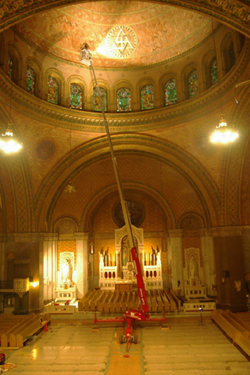 Interior investigation of dome |
Although most of the interior and exterior materials and construction systems were investigated as part of VA's survey, this article focuses on the Guastavino domes and vaults at St. Francis de Sales. Measuring 61 feet across at the base of the dome, the span of the central dome of the church is among the largest constructed by the R. Guastavino Company. Unique among the Guastavino domes in the United States, the central dome of St. Francis de Sales Church as well as the smaller domes at the street facades of the building, was designed and constructed using not only exposed Guastavino tile on the interior but also on the exterior. Another similar instance of a Guastavino tile dome exposed on the exterior is the Cathedral Church of St. John the Divine, but in that case, the dome covering the crossing was intended to be temporary and replaced eventually by a spire. Although the dome at St. John the Divine is still in place, it has been covered with a waterproofing membrane. In the case of St. Francis de Sales Church, between four layers of tile at the top of the dome and nine layers at the base were used to form the dome structure. The exterior Guastavino tile was polychromed and set in a decorative pattern incorporating herringbone patterns, decorative roundels, radial spokes and circumferential bands. By the 1950s, the condition of the exterior tile had deteriorated to the point that a major repair project was undertaken involving the application of a sprayed concrete substrate and installation of new glazed ceramic tile over the existing dome.
The vaults over the gallery, nave, transepts and sanctuary of the church are all constructed using Guastavino tile systems. The vaults are not true barrel vaults, but rather shallow hyperbolic paraboloids with a double curvature. At the interior, the exposed unglazed Guastavino tile is set in a herringbone pattern. The joints between the tile are pointed with a raised square profile ribbon joint. The overall effect of the Guastavino tile ceilings adds to the richness of the interior. On the exterior, the vaulted portions of the structure are covered with sheet copper and built-up membrane roofs.
The investigation of the existing conditions at St. Francis de Sales Church is still underway. Analysis of the survey findings is in process and the next phase of work will likely involve probes to determine subsurface conditions that could not be verified during the first phase of investigation. This work will include further assessment of the Guastavino domes and vaults, adding to our knowledge of this important system of construction. It will also provide information necessary to develop treatments and repair strategies for the restoration of this significant church.
For more information, view the project profile of Saint Francis de Sales on our website.
-Evan Kopelson [Photos by Jon Reis]
Kent's Trip to Spain
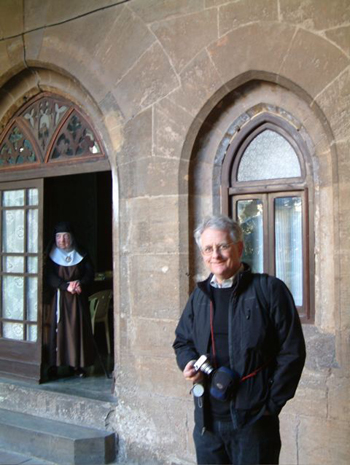 Kent at the Trinitarian convent |
In early December, Kent flew to Barcelona, Spain, to spend eight days with colleagues there, studying various types of masonry vaulting. While they looked at Roman, Gothic and Baroque buildings in Valencia and Barcelona, the primary focus was on Catalan tile vaulting, including some of the early work of Rafael Guastavino, completed before he emigrated to the United States in 1887.
Guastavino tile assemblies have been an interest at Vertical Access since the spring of 1996, when we first encountered this material at St Thomas Church, on Fifth Avenue in Manhattan. This interest was the inspiration for the one-day Symposium entitles "Preserving Historic Guastavino Tile Ceilings, Domes and Vaults" presented at Columbia University 1999 by the New York Landmarks Conservancy www.nylandmarks.org. The proceedings of this Symposium were published in the APT Bulletin, along with reproductions of Guastavino's United States Patents www.apti.org/publications.
More information on Rafael Guastavino may be found on the web here: http://en.wikipedia.org/wiki/Rafael_Guastavino.
Two years ago, Chuck DiSanto from Walter B. Melvin Architects and Kent were invited to Barcelona to speak at an annual conference hosted by the Collegi d'Arquitectes de Catalunya. This meeting led to introductions to a number of Spanish preservation colleagues, some of whom have visited in New York in the last few years. Notable among these are Jose Luis Gonzalez, Mar Loren, Fernando Vegas Lopez-Manzanares, Camilla Mileto and Gloria Riba Francas. Fernando and Camilla both teach in the architecture department at the University of Valencia as well as run an architectural practice together and co-edit the Conservation journal, "Loggia".
The first few days of the trip were spent in Barcelona where they visited the Batllo textile factory, since converted into an art museum, and the Exhibition Hall built in 1930.
The next day and a half were spent in Cadaquez, just south of France, in the "Costa Brava". This rugged coastline is a popular vacation destination but was nearly empty of tourists during this time of year. While in Cadaquez, Gloria and Kent looked at some local examples of Catalan vaulting, including some contemporary work completed in the last 20 years.
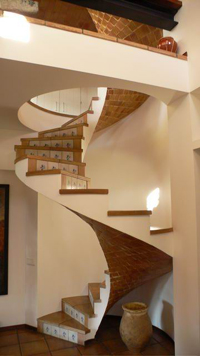 Contemporary Catalan vaulting in Cadaquez |
Upon returning to Barcelona, Kent and Gloria traveled to Valencia by train, where they were met by Fernando and Camilla. The afternoon was spent looking at some of the beautiful blue-tiled domes in the historic core of Valencia, and a late lunch of vegetarian paella, before Kent gave a lecture to the preservation students on our work at Vertical Access, and the TPAS documentation approach that we have developed.
The next day began at the Trinitarian Convent where they were joined by Arturo Zaragoza Catalan. Arturo is an authority on Mediterranean Gothic architecture and has written several exhaustive treatises on the subject. Among other things, we learned about the use of large amphoras to fill the interstitial spaces in gothic vaults, a technique observed by colleagues at Robert Silman Associates (www.rsapc.com) and Pantel delCueto & Associates in San Juan, Puerto Rico at the Iglesia de San Jose.
The entire day was filled with visits to a number of important architectural monuments, including the Iglesia Catedral Basilica Metropolitana de Santa Maria with a special focus on the work of the Master Builder Baldomar in the mid-fifteenth century. The work of Baldomar features a number of oblique window and door openings as well as enormous stone vaults, built without groins. That evening found them back in Barcelona, arriving late at night, by car.
The next morning Kent, Fernando and Camilla had an appointment at another textile factory now housing the Escuela Industriale, reportedly the first building designed by Rafael Guastavino before he emigrated to the United States, at the age of 26.
Meeting up with Gloria at mid-day, the four of them drove to Terrassa, about an hour north of Barcelona, for a visit to the Museum of Science and Technology, housed in the former textile factory.
 Museum of Science and Technology in Terrassa |
They were welcomed there by Jaume Matalama i Cura, a close friend of Gloria's, who gave them a personal tour of the facility, explaining the function of the building as well as the exhibits. This collection of industrial technology equipment and artifacts is one of the finest in the world and is worthy of a visit by anyone visiting this area of Spain. The building itself is exquisite and is one of the most unusual but highly functional examples of industrial architecture to be found anywhere.
The next day, the group headed north, into the Pyrenees, to have a look at the Asland Cement Factory, now a museum, also under the supervision of Jaume. As a result of his introduction, we were allowed full access to the site and were able to closely examine three new Catalan vaults in various phases of construction.
The last full day in Spain was spent resting and exploring Barcelona and the flight back to JFK was filled with warm thoughts about good friends and good times recently experienced in Spain. -Kent Diebolt
For more information, please see the Guastavino page on VA's website.
Vertical Access Expands Access Consulting
As a natural extension of its work accessing hard-to-reach locations, Vertical Access has recently completed a number of projects solving difficult access issues. Ideally planned for and designed into a building, access systems for ease of continued maintenance are often value-engineered out of important projects, leading to interesting access challenges. Vertical Access works with clients to engineer a range of potential solutions that are then evaluated for cost, ease of use and other parameters so that in-house maintenance can be completed safely and efficiently.
The United States Courthouse and Federal
Building
The US Federal Courthouse in Islip is a recent example illustrating
VA's access consulting work. Vertical
Access was hired by Perkins Eastman to solve a number of access
challenges created by access systems that were planned for but were
later omitted from the building design.
New York State Pavilion
Observation Tower
Another recent access solution VA devised was for
the New York City Department of Parks and Recreation.
The DPR of Queens, NY is responsible for the 1964 World's Fair
Site, located in Flushing, Queens at Corona Flushing Meadows Park.
The remaining observation towers of the New York State Pavilion,
abandoned for the past 43 years, rise to a height of 240' and require
proper illumination by the Federal Aviation Administration (FAA) due to
the proximity of LaGuardia Airport, three miles to the west.
The original elevators and stairs are no longer in serviceable
condition so maintaining an FAA-approved beacon at the top of the tower
has become a challenge. VA
was able to consult with DPR and an electrician (Sparks Electric
Company) to keep the existing beacon lit while developing different
alternatives for future maintenance access.
The resulting report recommended the installation of a more
efficient LED fixture that would extend the service life of the beacon
for over ten years and outlined a number of access options for the
eventual maintenance of the new beacon.-Kelly Streeter
For more information, please see the access consulting page on VA's website.
VA in the News: Kent Diebolt and Paul Gaudette Named to APTI College of Fellows
 The
College of
Fellows fulfills a variety of salient functions within APT. Overall,
the college advises the Board of Directors on issues regarding the
advancement of philosophy and practice of preservation technology.
The
College of
Fellows fulfills a variety of salient functions within APT. Overall,
the college advises the Board of Directors on issues regarding the
advancement of philosophy and practice of preservation technology.
2007 APTI Conference in San Juan

|
The conference will be held November 3-7 at the Caribe Hilton in Puerto de Tierra, just outside of the historic walled city of Old San Juan. Current plans are to have workshops on lime plasters and mortars and wood conservation on Nov. 3-4 along with an American Institute for the Conservation of Historic and Artistic Works (AIC) Angels Project that will be a hands-on conservation project. The main conference with paper presentations and numerous social events held under the Caribbean stars will take place Nov. 4-7.