Cathedral Basilica of Saints Peter and Paul
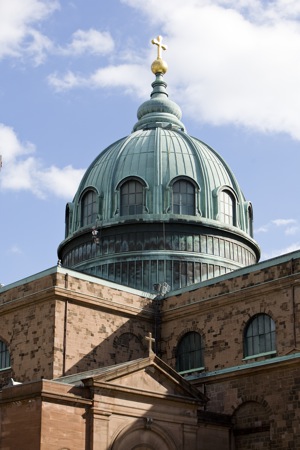
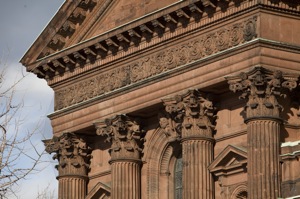
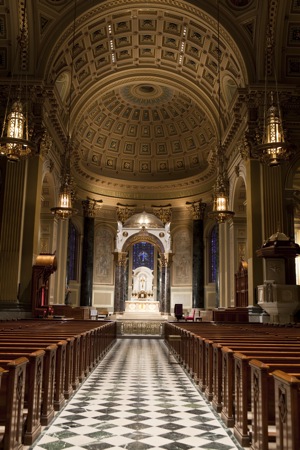
The Cathedral Basilica of Saints Peter and Paul in Philadelphia was designed by John Notman and
Napoleon LeBrun and constructed between 1846 and 1864. The exterior walls are load-bearing masonry
faced with brownstone. The copper-clad dome rises from the crossing of the Cathedral, with the top
of the dome approximately 200 feet above the ground. A sheet copper-clad spire surmounted by a
gilded cross sits atop the dome. The existing sheet copper cladding is believed to have been
installed in the 1950s to replace an earlier copper re-roofing of the dome, which in turn replaced
the original sheet tin roofing.
The dome is divided into 12 equal facets by molded sheet copper-clad ribs. Between the
ribs are sheet copper pans. The pans have folded horizontal seams. The vertical seams between the
pans are covered by smaller vertical ribs. Pieces of formed sheet metal span between the smaller
ribs in two rows at each facet, acting as water diverters. At the bottom of each facet is an arched
copper-clad dormer window. An important component of Vertical Access' investigation was to measure the thickness
of the existing copper cladding using an ultrasonic thickness gauge to determine how much section
loss has occurred over the 50-year life of the cladding.
The ultrasonic thickness gauge works by coupling a probe to the material being tested
and then sending a pulse into the material. The pulse gets partially reflected when it reaches a
boundary in the material, in this case, the inside face of the copper. Based on the speed and return
time of the pulse, the gauge can determine the thickness of the copper. Calibration of the gauge is
necessary because different metals will transmit the pulse at different speeds. Therefore before any
measurements were taken, a piece of copper having similar thickness to that of the dome’s cladding
was measured with a micrometer, and then measured with the gauge as part of the field calibration.
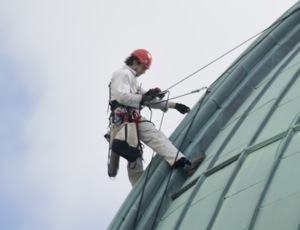
Vertical Access technician Dave Dayan used our StressTel TM1-CD ultrasonic thickness
gauge to test the thickness of the copper on the dome at 25 locations on five different facets.
Based on a measurement from the inside of a window, it was determined that the copper was 24 gauge
(16oz), which has an original thickness of 0.022". On average, there was only about a 10% section
loss, a pleasant finding given the 55 years that the cladding has been exposed in an urban
environment. Although the total amount of loss of copper thickness has been determined, the current
rate of deterioration is not yet known. Measurements should be taken at the same locations in
future years to determine the present rate of section loss, which can accelerate as the material
ages.
This project was also the first use of our new video equipment including a new high
definition camcorder, high definition flat screen monitor and 500’ long cable. The new video camera
and monitor provide a much higher definition picture than previously possible, which allowed the
client and architects to clearly see the dome’s construction details as it was broadcast to them in
a ground floor conference room from 200 feet above. The Owner and Architect were able to
communicate with Vertical Access staff via radios and to a great degree direct the video
documentation. The new cable is easier for Vertical Access technicians to manage and deploy than
our previous cable.
See the Cathedral Basilica of Saints
Peter and Paul project profile.