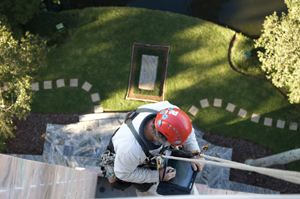
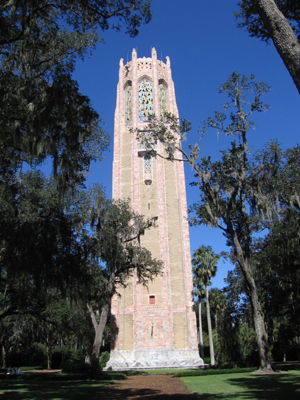
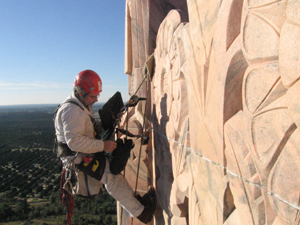

Photographs by Cassie Jacoby of Bok Tower Gardens
|
|
Bok Tower
Medary was directed by Bok to "create a Tower as beautiful as that at Mechlin, Belgium, but
adapted to the gentler and warmer climate of Florida." Construction of the Tower began
in 1927 and the tower was dedicated in February 1929. Bok Tower Gardens is a National
Historic Landmark, and is featured in the National Park Service's 2009 calendar of National
Historic Landmarks.
In plan, the 205-foot tall tower is square at the base and transitions to an
octagonal tower at an elevation of 142 feet above grade. The tower is a steel frame
structure clad in marble and coquina stone. Gray Creole marble from Georgia is used at the
base of the tower. Pink Etowah marble, also from Georgia, is used for the decorative
carving, quoining, buttresses and masonry at the surrounds of the panel openings. Florida
Coquina stone carved into ashlar blocks and set in random coursing comprises most of the
cladding at the square-plan portion of the tower.
Bok Tower incorporates Gothic elements, such as pointed arch openings and tall
corner buttresses, and Art Deco touches, such as the polychrome tile panels filling the
openings and geometric parapet carvings. The focus of VA's recent investigation, performed
with Robert Silman Associates and Lord, Aeck & Sargent Architecture, was the tile panels
and the masonry surrounds at the openings where the panels are located. The tile panels
are a character-defining feature of the tower and contribute to its uniqueness.
The decorative panels consist of a cast iron frame into which are set
polychrome tile. The tiles are nominally 3/8" thick and have a red clay body and smooth
ceramic glaze. The tilework was designed and fabricated by the Enfield Pottery and Tile
Works in Enfield, Pennsylvania. At each of the tall arched openings at the eight facets in
the octagonal portion of the tower are tile panels depicting trees with birds. These
panels were designed with two distinct patterns: at the facets facing the cardinal
directions (north, west, south, east), there is a pair of monkeys at the bottom of the
panels; at the minor facets, there is a pair of birds at the bottom of the panels. The
tile panels at each facet are comprised of seven sections, stacked vertically and bolted
together at the top and bottom.
Below the arched openings on the north, west, south and east facades are
rectangular openings with tile panels consisting of five sections. Two tile patterns, Adam
and Eve in the Garden of Eden on the north and south and a group of birds on the west and
east, are depicted. The configuration of the five sections is two horizontal panel
sections above a series of three vertical panels, the middle of the three being a door that
opens onto a balcony with a wrought iron parapet.
The lowest series of tile panels fill arched openings in the masonry that are
shorter and narrower than the uppermost openings. These panels are located on the north,
west, south and east facades and consist of two patterns. On the north and south facades
there are fish swimming above a jellyfish and on the west and east facades are fish
swimming above a seahorse. The sections with the jellyfish and seahorses are doors that
open onto a small balcony with a stone parapet. Although the tiles and cast iron frames
are in relatively good condition for their 80 years, the mild steel frames to which they
are attached show signs of deterioration. The treatment of the tile panels will be the
priority of future restoration work at the tower. Planning for restoration work is
currently underway.
See the Bok tower project profile.
|
