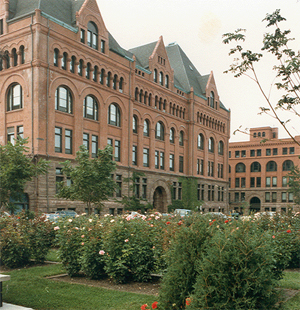
The Main Building was designed by the Chicago architecture firm of Patton & Fisher in 1891 and constructed between 1891 and 1893 for the newly formed Armour Institute of Technology.
The Amour Institute was created by the Chicago minister Frank Gunsaulus with the financial backing of Philip Danforth Armour, a local meat packer and grain merchant. The Main Building,
located on the southwest corner of South Federal and West 33rd Streets, originally provided classroom and office space for the institute when it opened in 1893.
Illinois Institute of Technology was formed in 1940 when the Amour Institute merged with the Lewis Institute, another Chicago college. As the school expanded, the role of the Main Building
changed. The building, situated at the western edge of the IIT campus between Mies's one to three-story modernist structures and raised railroad tracks of the Metra commuter rail, now houses
administrative offices.
Although distinct from and somewhat marginalized by the modernist buildings adjacent to it, the Main Building possesses historical and architectural significance as one of only two surviving structures
from the Armour Institute and as a notable example of Romanesque Revival design. The Main Building is rectangular in plan and symmetrical in overall form, with the longer façades facing east and west
and the shorter façades on the north and south sides. The five-story structure is built of masonry, with rough-finished dark red sandstone at the basement and first floor and smooth red brick and terra
cotta at the upper floors. Characteristic features of the exterior include the use of dark-colored masonry materials with contrasting surface textures, regular arrangement of rectangular and round-arched
window openings and steep roof lines with large gable-fronted dormers. A two-story annex structure constructed of similar sandstone and red brick adjoins the south side of the Main Building.
Beginning in 2006, Harboe Architects has been involved with the rehabilitation of the Main Building. A Master Plan completed in 2006 identified and prioritized the repairs recommended for the exterior and
interior of the building. Vertical Access recently assisted Harboe Architects with the current phase of work at the Main Building, which includes preparation of construction documents for the restoration
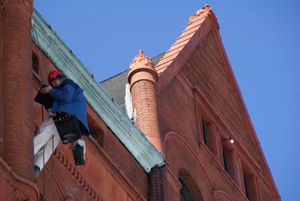
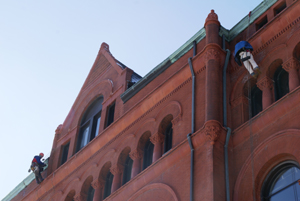
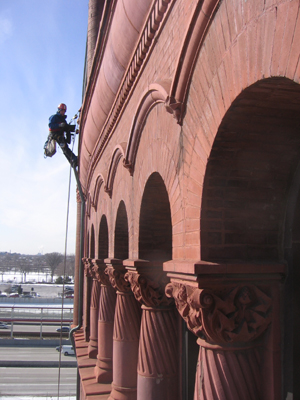
of the exterior masonry. In February 2008, VA performed a hands-on investigation of the exterior masonry. This work, carried out over four days, included sounding of the sandstone, brick and terra cotta
masonry and documenting the existing conditions by means of annotated elevation drawings and over 800 photographs.
VA's survey was performed using industrial rope access techniques, which allowed safe and efficient access to all areas of the exterior façades. Because of the retaining wall and raised railroad tracks
adjacent to the west side of the site and steep gable and hipped roofs, other means of access such as aerial and hanging platforms would not necessarily allow access to all exterior areas. Although pipe
frame scaffolding could be erected to perform the survey, considerable costs would be incurred. As recently recognized by the City of Chicago Department of Buildings, means of access other than scaffolding
can be used to provide inspection services at potential cost savings. Industrial rope access is one such means of access.