
|
In this issue... |
|
USMA Cadet Chapel and Thayer Hall ________________________
To be removed from or subscribe to this newsletter,
please email newsletter@vertical-access.com
To view previous VA Quarterlies, please go to our website
|
|

USMA Cadet Chapel and Thayer Hall
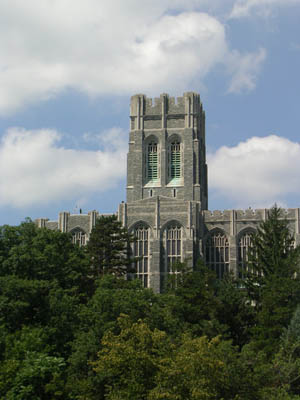 Cadet Chapel East Facade |
Over three weeks in December 2005, Vertical Access
performed comprehensive investigations of the Cadet Chapel and Thayer
Hall, two historic buildings on the campus of the United States Military
Academy (USMA) in West Point, New York.
Working with QPK Design
and John P. Stopen Engineering Partnership, both of Syracuse, Vertical
Access surveyed the entire exterior of these two masonry structures,
performed non-destructive investigation of the drains and leaders at
each building and examined the condition of portions of the Chapel
interior where additional documentation was requested.
In 1904, the
architectural firm of Cram, Goodhue & Ferguson won a competition to
design several new structures at the USMA. As part of this commission, the Cadet Chapel and the Riding Hall,
now known as Thayer Hall, were designed and constructed in the first
decade of the 20th century. The design of both structures utilizes the vocabulary of the
Gothic Revival style that Ralph Adams Cram and Bertram Grosvenor Goodhue
also incorporated into other buildings at West Point and into later
collegiate and ecclesiastical buildings.
Situated on a
hillside near the high point of the USMA campus, the Chapel overlooks
the academic, administrative and barracks buildings of the academy and
the Hudson River below and to the east. The Chapel, oriented with the main entrance on the north side of
the building, has a traditional cruciform plan with a long nave and side
aisles leading to the chancel and sanctuary at the south end of the
building. The 145-foot tall
bell tower rises above the crossing of the transept.
Thayer Hall,
situated on the West Point Plain overlooking the Hudson River, was
originally designed and built as a Riding Hall containing one large
free-span space in the main portion of the building, with horse stables
and a hay loft located in adjoining structures. Between 1955 and 1959, the Riding Hall was converted into an
academic building and renamed Thayer Hall. Four levels of classrooms and offices were inserted into the
building at the interior and a parking deck was constructed on top of a
new roof structure. A
vehicle bridge accessing the roof-top parking and pedestrian bridges
leading to the various interior levels were also added at that time.
The Cadet Chapel and Thayer Hall are both constructed of load-bearing masonry with gneiss units set in
random ashlar coursing and limestone used for window surrounds, parapets
and other trim and ornament. The
choice of building stone is in part due to its availability, as West Point
was a quarry site for the granitic gneiss used in many of the historic
buildings built at the academy. The
particular gneiss used in these structures reportedly came from a site
behind the Superintendent's Quarters. The source of the limestone used at the Cadet Chapel is not
known, but it appears to be a homogenous, buff-colored limestone such as
Indiana limestone
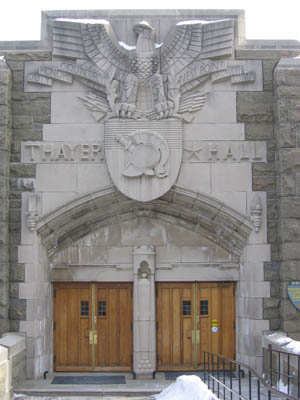 Thayer Hall |
The focus of VA's investigation at both structures was on
the condition of the limestone and gneiss masonry comprising the
structures' facades. The
location, severity and quantity of conditions such as loose and
displaced units, spalling and cracking in the masonry, missing or open
mortar joints and soiling were recorded on elevation drawings using the
Tablet PC Annotation System (TPAS). To help understand patterns of deterioration observed on the
exterior and provide documentation that QPK and Stopen Engineering use
in their analysis of the structure, VA also surveyed the interior of the
bell tower and portions of the crossing and nave at the Chapel.
System cracking, displacement, efflorescence and other conditions
at the brick facing of the tower and limestone ribs and Guastavino
vaults in the crossing and nave were documented.
Live-feed video of two sides of the Chapel bell tower and
transept provided the client with contextual information and a broader
understanding of the conditions observed and documented by VA
technicians. A VA technician
performing the video inspection described conditions observed at these
drops while other members of the project team watched the live-feed
video and listened to the narration. The project team members were in communication with the VA
technician by two-way radios, and could direct him to move closer to a
feature or condition, remove loose stone or mortar or perform another
action that would help in understanding the conditions of the structure.
Live-feed video was also used on the interior of the Chapel at
one section of the transept vault and a bay of the nave.
At these areas, VA provided a closer look at the Guastavino tile
vaults and associated limestone groins where signs of water penetration
and displacement had been noted.
As part of the investigation of each structure, VA
also examined and documented the condition of the roof drains and
internal leaders using the See Snake, a diagnostic fiber-optic tool. The See Snake utilizes a miniature color video camera with a
wide-angle lens and built-in light source attached to 200 feet of rigid
video cable. A live feed
video and audio recording of the work was made on site during the
investigation.
The survey of the Cadet Chapel and Thayer Hall
performed by Vertical Access in cooperation with QPK Design and Stopen
Engineering is the first step in the conservation of these two
significant structures. This
step involved the investigation and documentation of the existing
conditions to identify areas and patterns of deterioration. The next step, currently being performed by QPK and Stopen
Engineering, is the analysis of the information collected during the
survey in order to develop treatment options.
For more information, view the project profiles of Cadet Chapel and Thayer Hall on our website.
-Evan Kopelson [Photos by Evan Kopelson and Mike Gilbert]
Vertical Access Joins 1% FOR THE PLANET
 |
While riding the chairlift at Whiteface Mountain in the Adirondacks in January, my dad and I were discussing environmental problems and the potential for businesses to confront and help remedy them, above and beyond the taxes we pay and other input into the political system.
I had recently seen Yvon Chouinard of Patagonia speak at Macalester College, in Saint Paul, Minnesota, about an alliance of concerned businesses he had founded - One Percent For the Planet.
One
Percent For The Planet is an alliance of businesses that recognizes and
takes responsibility for the damage businesses do to the environment
every day. To date, over 250 businesses have joined together and
pledged to donate at least one percent of their annual net revenues to
environmental causes. Members represent a wide range of service
providers and manufacturers, both large and small.
After
conducting some additional research and discussing the idea with
Vertical Access' accountant and lawyer, my Dad decided it was time to
"put our money where our mouth is" and make an ongoing
commitment to improving the environment by joining One Percent For The
Planet. We reasoned that with such a wide range of approved
organizations to support, we could make a difference within the context
of an organization that had an impact in our industry.
In
addition to supporting a wide variety of environmental advocacy,
education and researche organizations, members of One Percent For The
Planet are also proving that
environmental responsibility can actually be good for business.
Vertical
Access is proud to make a company-wide commitment to a sustainable
environment and we urge all of our friends in the preservation,
architecture and engineering fields to consider joining us in this
effort.
For
more information, please see www.onepercentfortheplanet.org
-Asa Diebolt, Director of Philanthropy for Vertical Access LLC
At Vertical Access, we have recently encountered and solved a hardware problem with the digital cameras we use during TPAS field surveys. We use Canon A510 compact cameras for fieldwork. The lens cover on the Canon A510 is a two piece aperture that opens when the camera is turned on. During inspection drops the camera remains on with the lens cover open. It appears that fine grit was finding its way into the lens cover mechanism and causing it to jam. Some of the lens covers would open part way, others would get stuck open or stuck closed. During the past summer, the automatic lens covers malfunctioned on five of our six cameras.
 |
 |
| Front of camera enclosure | Back of camera enclosure |
Canon repaired our cameras under warranty, but the lens cover malfunctions and the resulting unreliability were a recurring problem. We considered abandoning the A510 for a different model camera, but since all of the Canon A-series cameras use a similar lens cover design, it seemed likely that other camera models would have similar problems. Our solution was to outfit our cameras with waterproof housings. Although water housings are usually used by divers for underwater photography, they can also serve terrestrial duty by protecting cameras from impact and dirt.
Water housings are now available for most digital cameras. We use the Canon WP-DC60 housing, which is designed specifically for the A510 camera. Although the suggested retail price for the housing is $240, we were able to purchase it through the B&H Photo website for $170:
The housing is a hinged, two-piece clamshell type design, constructed of clear polycarbonate plastic. O-rings seal the joint between the two halves of the housing and all of the apertures for camera controls. Each button and switch on the camera has a corresponding button or lever on the outside of the housing, so all camera functions are available when the housing is in use.
 Camera connected to tablet via USB connection |
Because the camera is connected to the Tablet PC by a USB cable during a survey it was necessary to cut a small port in the side of the housing. We used a Dremel-type rotary tool to cut the cable port.
While it is unfortunate that we had to invest still more money in hardware, the cameras are now very well protected and we look forward to using them for years to come.
For updated downloads to use the TPAS system, including the program required to run remote capture with TPAS, go to the TPAS download page on our website. -Mike Gilbert [Photos by Mike Gilbert]
In
1980, a pedestrian was killed when a piece of a cornice fell from the
facade of a building in Manhattan.
Subsequently, New York City's Building Code was amended to
require inspection of the street facade(s) of buildings over six
stories under "Local Law 10." For
all applicable buildings, Local Law 10 required that a report prepared
by a licensed architect or engineer be filed with the Department of
Buildings every five years.
Local
Law 10 was updated in 1998 and superceded by Local Law 11 that requires
a more rigorous investigation and reporting of exterior facade
conditions. Under Local Law
11, all exterior walls and appurtenances must be inspected,
specific causes of deterioration identified, and a timetable for repairs
established. A
requirement for the 1998 ordinance is that a minimum of one "physical
examination" - typically performed by means of a swing stage or
hanging scaffold - must be performed on a street elevation.
At the judgment of the engineer or architect, additional
inspection drops may be recommended to the building owner.
In
the Local Law 11 report filed with the Department of Buildings, exterior
conditions are identified as "safe," "unsafe," or "safe with a
repair and maintenance program." Sometimes the first examination of a building's side and rear
facades, Local Law 11 inspections often lead to comprehensive conditions
reports, restoration projects, and maintenance programs. New
York City is now in its 6th Cycle of Local Law 11 and
Vertical Access has assisted several building professionals with surveys
related to the current round of the facade ordinance.
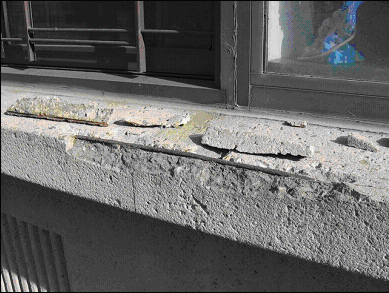 Typical spalling at window sills at Towers on the Park |
In October 2005, Vertical
Access assisted Wank Adams Slavin Associates (WASA)
with an extensive conditions assessment of Towers on the Park
condominiums located at Central Park West and 110th Street in
Manhattan. Based on
WASA's preliminary binocular survey and subsequent recommendation to
the client, Vertical Access' survey extended well beyond the minimum
requirements for Local Law 11 and consisted of a thorough assessment of
facade conditions. In this
project, Vertical Access found numerous concrete cracks and spalls that
may have been classified as "unsafe" under the rubric of the
Department of Buildings. Fortunately, all hazardous conditions
identified were temporarily abated during the course of the inspection
and the building is currently planning a repair program based on the
Vertical Access survey. At Towers
on the Park, Vertical Access utilized
the Tablet
PC Annotation System ("TPAS") to input quantities and types of
failures with graphic symbols and photographs directly in AutoCAD while
on site.
Since 1998, Vertical Access has completed over 125 Law Local 11 inspections for dozens of architects and engineers in New York City. Industrial rope access techniques have proven appropriate, safe, easy, and sometimes the best option for many Local Law 11 projects. While not necessarily the most economic option for a basic, single inspection drop, rope access offers the added value of an increased sample size (i.e. multiple drops in the same mobilization), greater safety or convenience for building occupants, and the ability to reach complicated or difficult-to-rig features such as towers, steeples, high parapet walls, cupolas or chimneys. --James Banta [Photos by James Banta and Kent Diebolt]
For more information on Local Law 11, please see our January, 2004 newsletter.
For more information on Towers on the Park, see our December, 2005 newlsetter.

According to today's broad definition of "historic resource," buildings, objects and landscapes are now an important part of a broader cultural environment. Diverse cultural resources are being conserved and "modern" resources and technologies that created them are being acknowledged. APT 2006 will explore the challenges and rewards of this current perspective on the historic, which includes recent events, diverse cultural perspectives, and innovations in architecture, industry and technology.
The conference theme, while addressing issues that apply to the entire preservation community, relates directly to Atlanta, which evolved from a railroad terminus into a commercial and transportation hub. Atlanta and the southeast region embrace our cultural resources as well as our "historic" modern structures.
The conference will be held at the Atlanta Hilton in the heart of downtown Atlanta, Georgia. Come visit us in Atlanta, and enjoy all of the hospitality that the southeast region has to offer.
- From www.apti.org
See the APTI website for more information.