
|
In this issue... |
|
Working Inside: 7th Regiment Armory Technology Highlight: TPAS Update: In the Field
________________________
To be removed from or subscribe to this newsletter,
please email newsletter@vertical-access.com To view previous VA Quarterlies, please go to our website ________________________
|
|
|
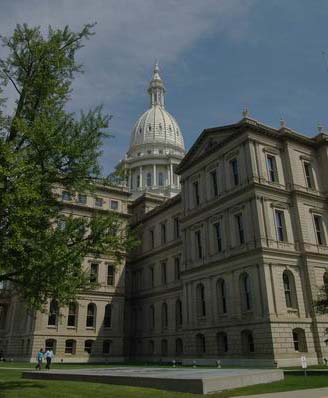
Michigan State Capitol
 |
|
| Michigan State Capitol |
On September 6 and 7 Kent Diebolt and Evan Kopelson
of Vertical Access surveyed the dome of the Michigan State Capitol.
The capitol building is a prominent Neoclassical structure at the
center of Lansing. It was designed by Elijah Myers, who went on to design state
capitols in Texas and Colorado, and built between 1872 and 1878.
The lower four floors of the Michigan State Capitol are
constructed of a yellowish-brown Berea sandstone. A central metal-clad dome rises to a height of 267 feet above the
ground. The
pedestal and arcade of the drum are clad in cast iron and the rest of
the dome, comprised of the attic of the drum, dome proper, and lantern
with finial, are clad in galvanized sheet metal.
The entire
dome was repaired and repainted in 1990 as part of a comprehensive
restoration of the capitol building undertaken between 1988 and
1992. Repairs performed at that
time included sheet metal patches, replication of ornament, and sealant
repairs. All of the
existing paint at the cast iron and sheet metal cladding was removed by
either commercial blast cleaning or chemical stripping, respectively,
and new paint coatings applied as part of the repainting program.
The purpose of the survey was to assess the
condition of the existing exterior paint coatings at the metal cladding
and wood windows of the dome. The
condition survey undertaken by Vertical Access is one component of the
project management services provided jointly by The Christman Company
and Quinn Evans Architects for the current Michigan State Capitol
Repairs and Modifications project. During the two days
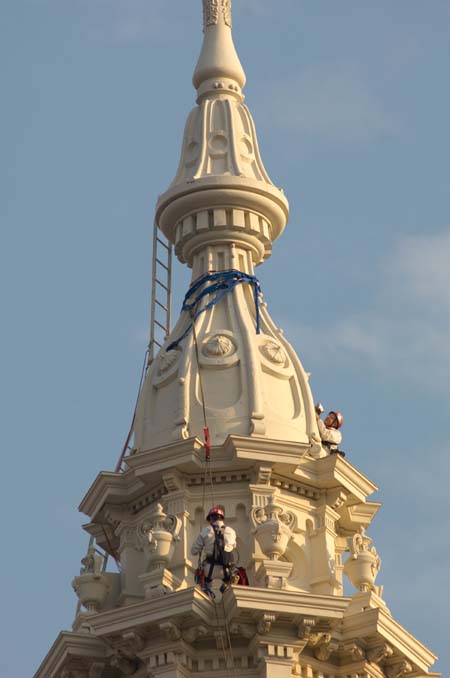
of fieldwork, VA performed four drops using rope access equipment
covering the dome from the top of the lantern to the base of the drum.
The finial at the uppermost portion of the lantern was surveyed
from the exterior ladder at the northeast side of the lantern. This provided close visual and hands-on access to nearly the
entire dome structure.
 |
|
| Kent Diebolt and Evan Kopelson on the Capitol |
Given the
extreme exposure of the coatings to harsh summer and winter
environmental conditions and their 15 years of service life at this
point, the existing coatings on the capitol dome are in remarkably good
condition. Minor areas of
paint loss and some corrosion, especially at leading edges and highly
decorative ornament, were noted, but for the most part the paint
coatings have performed as well as can be expected. The overall good condition of the paint coatings gives testament
to the care taken in material selection and the diligence shown in both
substrate preparation and application of the coating products.
The exterior paint used during the 1990 restoration was Imrona
polyurethane enamel, a high quality automotive finish manufactured by
DuPont. At the time of the
restoration, the entire dome was covered with a pipe frame scaffold,
allowing for controlled application of the coatings, which were
spray-applied.
During the fieldwork, VA also noted the immaculate appearance of all of the spaces accessed to set up the rigging and perform the survey. Even parts of the interior dome where visitors are not permitted were clean and well maintained. This fact speaks well to the facility operations and maintenance group at the Michigan State Capitol. The maintenance staff was also more than gracious in assisting VA during the survey, even helping to haul 50-pound bags of equipment up narrow interior ladders to get to the top of the dome.
For more information on the Michigan State Capitol project, see the project profile.
-Evan Kopelson, Photos by Kent Diebolt
Working Inside: 7th Regiment Armory
 |
 |
|
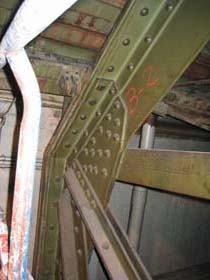
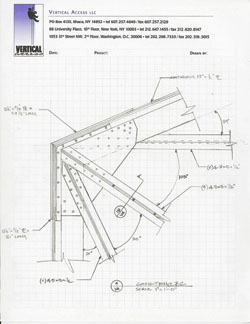
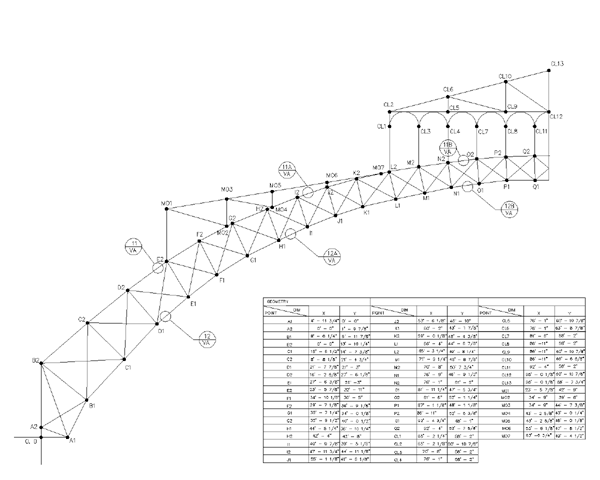
| A photograph and a detail from the trusses at the 7th Regiment Armory | ||
The armories of New York City, of which there were originally 29, were constructed starting in 1877 as a meeting place and drill hall for the local volunteer militias of the day. The 7th Regiment Armory, which was the first ever constructed, extends the entire block between Lexington and Madison and 66th and 67th streets on the upper east side. The fear of anarchy at that time was so powerful that the building was actually finished in large part with the help of the wealthy New York families the Astors and Vanderbuilts, who contributed over $589,000 when funds ran out mid-construction.
Belying their supposed utilitarian function, armories were often very ornate structures and doubled as mens' clubs. The 7th Regiment, which was designated as a landmark in 1994, was known as the premiere club of the day and housed some of the finest interior spaces of the 19th century. In fact, the architect of the armory, Charles Clinton, was also a member of the local militia.
 |
|
| Elevation of drill hall truss |
Each armory was designed with two separate spaces, a two to four floor area, which housed the offices, dining areas and housing for the militia and a large drill hall - a column-free vaulted space which allowed for the militias to meet and practice in a large, unobstructed space. Built with the same technology as the railroad stations of the day, the drill hall roof is supported by large iron trusses.
These trusses are the primary interest for Robert Silman Associates (RSA), the structural engineer hired to evaluated their capacity. RSA hired Vertical Access to create a dimensioned elevation of the typical truss and to detail all of the connections so as to create computer model of the trusses. This structural model will allow RSA to determine the truss capacity in order to help the armory weigh potential uses for the drill hall. The 7th Regiment Armory.
The Conservancy proposes the creation of a unique cultural institution at the Seventh Regiment Armory, which would bring extraordinary arts programming to one of the City's most beautiful landmark buildings. The Conservancy will feature exhibitions, performances and events that will include dance, music, and the visual arts. One of the Armory's hallmarks will be its ability to easily adapt its wonderful space to a wide variety of major arts and cultural offerings. As a hybrid of the visual and performing arts, it will provided offerings of outstanding quality and popular appeal. -From community relations materials of the 7th Regiment Armory.
-Kelly Streeter
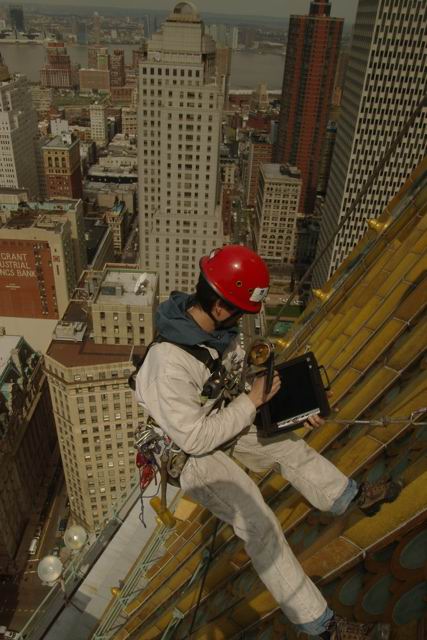
Development of the Tablet PC Annotation System (TPAS) is the culmination of 13 years of Vertical Access (VA) experience investigating building conditions. The past five years have been spent refining this documentation solution to streamline the evaluation of facades and the presentation of data to VA clients. TPAS allows us to annotate AutoCAD drawings directly in the field, streamlining the report preparation process and improving the end product delivered to the client. The recently developed remote capture feature allows for all project-related photographs to be automatically catalogued in the field, with a hyperlink associating each multi-media file with a unique location on an elevation.
After years of development,
tweaking, and
equipment
evaluation and purchases, we are beginning to reap
great benefits from using TPAS in the field. After the completion of a few large-scale projects, we recently evaluated
our experiences with the system to determine what works well and what
doesn't, as we seek
to improve
this new tool.
Thurgood Marshall: The
First TPAS Project
 |
|
| TPAS on Thurgood Marshall |
VA's first large TPAS project was the Thurgood Marshall Federal Courthouse in New York City, with site work finished over three weeks in March and April. Completed in association with Beyer Blinder Belle (BBB), Robert Silman Associates and Integrated Conservation Resources, Thurgood Marshall was a challenging first project for the system, given its large size and complex plan. Although the photo-linking and embedding was not fully developed in time for this project, we were able to fully utilize the TPAS annotation of drawings in the field. Not only did this greatly shorten office time for the data reporting to the client, it also allowed BBB to use the export feature in AutoCAD to help estimate quantities of conditions. Larry Gutterman, the project manager of the project for BBB says, "BBB found the export of data to spreadsheets to be quite helpful in validating the quantities of crack and spall conditions. This proved helpful when working with our client to evaluate the project's scope against available funding." For the complete story on the Thurgood Marshall Federal Courthouse project, see our June newsletter or the project profile.
While
on site at Thurgood
Marshall, we were introduced to both the pros and cons of working with
TPAS. As expected, the process of taking notes directly in AutoCAD
in the field did hasten the report preparation process by eliminating
the transcription step. However,
site security has taken on a whole new dimension:
a robust backup and version management protocol had to be
developed to ensure the safety of all captured data - one misnamed
file or damaged tablet PC could mean the loss of days of work product. Furthermore, the thousands of dollars worth of computer equipment
required heightened physical security --
each site office area needs to be set up behind a locked door
that remained secure at night.
 |
|
| TPAS export feature |
While
onsite at Thurgood Marshall, some
technician-related issues were also encountered on this first project. The addition of another piece of delicate equipment to a
technicians' person is always an adjustment. Also, the battery life of the tablet PCs on long drops can
necessitate the changing of batteries while on rope, which requires care
so as to not drop anything. This
issue will be resolved in the future as each technician becomes familiar
with the new setup.
Williamsburgh Savings Bank: Using Remote Capture
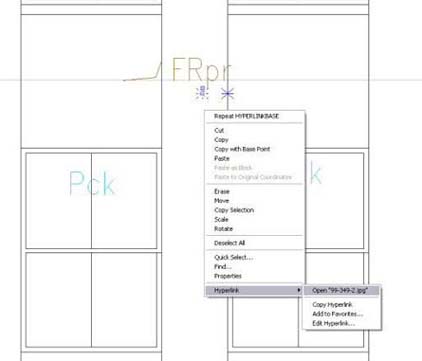
The Williamsburgh Savings Bank in Brooklyn, NY included inspection of terra cotta, brick, stone, and metal and was completed with LZA Technology entirely with the TPAS system, and was the first project to include the remote capture feature. Remote capture allows Vertical Access technicians to take digital photos on site and save them directly onto the tablet PC. Not only does this feature allow VA to name and store each photo file when it is taken, but more importantly it creates a hyperlink in the AutoCAD file at the location on the elevation where the photo was taken, which allows for swift electronic navigation to images when reviewing large reports.
 |
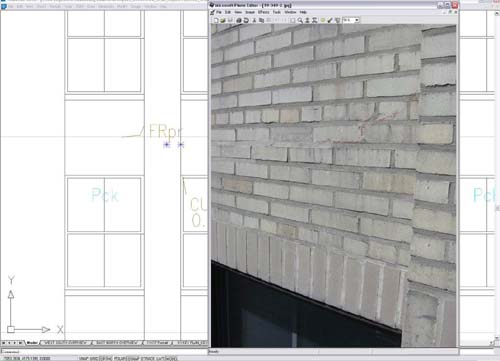 |
| Embedded hyperlinked photo tag | Open hyperlinked photo of condition |
In the post-site processing of data and files, the remote capture feature eliminates the extrememely time-consuming step of moving and renaming all digital photograph files, arguably the most wasteful and unskilled aspect of the office process.
The addition of the camera, which is presently hard-wired to the tablet PC, introduces yet another piece of equipment (and another backup battery) to carry. With all this tangle-prone equipment on a technician's person, organization is paramount. VA is currently looking into the Nikon Coolpix P1 and P2 digital cameras, which would allow the remote capture feature using wireless Bluetooth technology. For a review of this new camera, click here.
Moving
Forward
Once back in the office, the complications of dealing with site issues tends to melt away as the time saved in the preparation of deliverables can be significant. Notes taken with TPAS usually do not have to be altered or transcribed in any way, and the time saved using the remote capture feature for photography is well worth climbing the learning curve. Mike Gilbert, a 10-year veteran of Vertical Access and the resident AutoCAD maven, puts it simply, "With TPAS, preparing paper layouts for presentation of elevations takes the same amount of time as it used to. Photography is much faster and the homogeneity of the output will get better with time as we train each technician to take notes in the same fashion."
The
most important aspect of VA's adoption of the TPAS system is client
satisfaction. The ability
to export all conditions into a database format, and the ease of
hyperlink report navigation are proving important to our clients.
New features will be added to further improve our final product,
including linking of video and audio clips. All the components which comprise the TPAS system are open source
and available for download from our website.
Please note that this download includes files not previously available. As TPAS evolves, it will remain publicly available and all
feedback from users in the field is appreciated.
Vertical Access Employee Updates
Evan Kopelson
|
|
| Evan Kopelson |
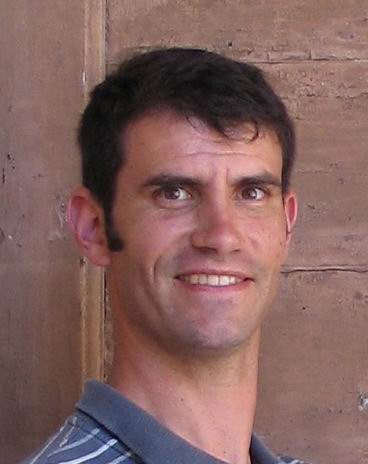
In early September, Evan Kopelson joined the Ithaca office of Vertical Access as Conservator and Technician. Evan, his wife Rae, and their son Thomas moved to upstate New York from the San Francisco Bay Area, inspired by Ithaca's natural setting in the Finger Lakes, diverse cultural offerings as a college town, and small-city pace of life.
The move is a return to Ithaca for Evan, who spent four years at Cornell University, and for Rae, who grew up in the area and also went to Cornell. In fact, the idea for Vertical Access first occurred to Kent 13 years ago when he was re-roofing the steep-sloped pitches of Rae's parents' house in nearby Lansing.
 |
|
| Andaleeb and James in Genoa |
Evan's first project with Vertical Access was the survey of the exterior paint coatings at the Michigan State Capitol dome, a national historic landmark designed by Elijah Myers and built between 1872 and 1878. It was the first time that Evan had employed rope access technology to perform survey work, although being high up in the air to inspect buildings and structures is not new to him. Previous to joining Vertical Access, Evan worked with Architectural Resources Group in San Francisco, where a highlight of his four years with the firm was surveying the 100-foot tall Watts Towers in Los Angeles from a 130-foot boom lift. Prior to ARG, Evan worked for Building Conservation Associates in New York City, where he spent a considerable amount of time on the pipe frame scaffold and swing stages that covered the 700-foot MetLife Tower during the exterior repair project on the building.
James Banta
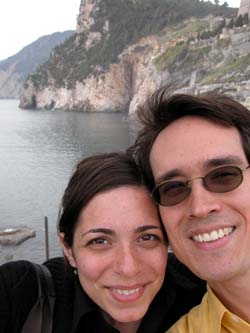
James Banta is back after a year-long leave-of-absence from Vertical Access. He accompanied his wife Andaleeb to Genoa, Italy where she was conducting archival research and writing her dissertation in Art History.
After returning to New York in August, James is back in the full swing of a busy VA summer and fall, working on the recently completed Williamsburg Savings Bank and other projects.